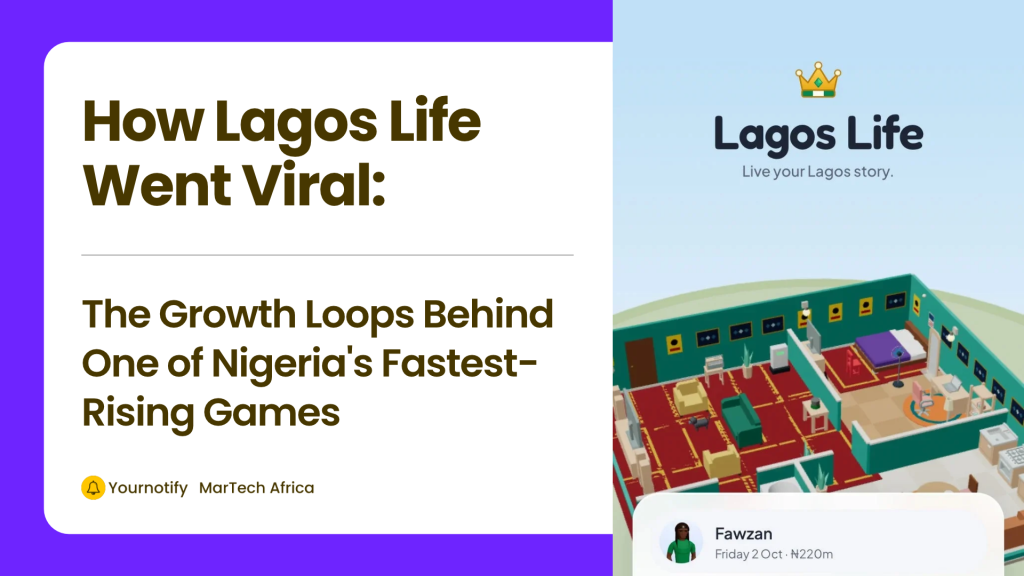
How Lagos Life went viral is one of the more instructive marketing stories to come out of Nigeria this year. A browser-based life simulator, built overnight and shared as a single link on X, reportedly reached more than 10 million players in under two weeks, with no paid media, no celebrity unveiling, and no app-store launch. The interesting question is not why people liked it. It is how a product with almost no marketing budget turned its players, its culture, and even its product updates into a distribution system.
Case Study
- Product: Lagos Life, a browser-based life-simulation game set in Nigeria
- Company: Vatar
- Founder: Shalom Rayhamen
- Launch: 1 October 2026, via a post on X
- Market: Nigeria
- Acquisition channels: Social media, word of mouth, user-generated content, and earned media
- Core advantage: Cultural recognition combined with near-zero friction between discovery and play
- Reported outcome: 10.15 million players and 49.2 million visits by 11 October (developer-reported)
- Key lesson: The product itself did the distribution work
Background: A Nigerian Life Simulator Built Overnight
Shalom Rayhamen grew up playing The Sims 3 and had long wondered what a life simulation would feel like if the world inside it looked more like Nigeria. The push to build it came after she saw Danfo Run, Opeyemi Adeniran’s browser game that puts players behind the wheel of a danfo in Lagos traffic.
She started building at about 9 p.m., worked through the night, and published Lagos Life on X at 7:11 a.m. on 1 October. By around 10 a.m., people were already playing and talking about it.
There was no teaser campaign, no pre-launch influencer programme, and no store listing. There was a link, and a story about why the game existed.
The Challenge: Earning Attention With No Marketing Budget
Every new consumer product has two problems. People must find it, and then they must care enough to try it. Lagos Life had no established franchise behind it and, according to Rayhamen’s interview with PINCHED, no money spent on marketing.
So the real question was this: why would someone scrolling past a post on X stop and play?
The Insight: Nigerians Did Not Need the Game Explained
Lagos Life keeps the familiar loop of a life simulator. You create a character, find a job, earn money, pay rent, eat, socialise, and try to move up. What changes is the world around those mechanics: danfos, power problems, landlords, nightlife, local food, property, and the constant pressure to improve your position. Players are even given their economic starting point, including the tongue-in-cheek “Nepo” and “Lapo” categories.
That matters because the game did not have to teach players why its world was funny. They already knew. Rent became gameplay. Class became a starting condition. Hustling became progression. Status became something you could display.
This is localisation as product design, not decoration. A flag on a generic simulator would not have produced the same effect.
Related: Why Feedcover Is Building the Missing Middle of African Content
The Distribution Mechanism: The Link Was the Funnel
Lagos Life ran directly in the browser. No download, no console, no app-store search. A person could see a post, tap the link, and be playing within seconds.
WeeTracker argued this distribution model mattered as much as the Nigerian references. In a market where device storage, data costs, hardware, and payment friction limit access, the browser turned the shared link into the acquisition funnel. The journey was simply: see it, tap it, play it.
For viral products, this is critical. Curiosity decays quickly, and every extra step between discovery and experience is a chance to lose the user.
How Lagos Life Went Viral: Five Growth Loops
No single post explains the growth. The evidence points to several loops reinforcing one another.
Loop 1: Player experience becomes shareable content
A player discovers the game, plays, and something funny, frustrating,ating or aspirational happens. They post a screenshot. Their audience sees it, clicks, and plays.
Players shared their virtual lives, usernames, and screenshots across social media. One player posted about going from Yaba to “Ikoyi Billionaire.” Others shared traffic, wealth, and job moments. The jokes worked outside the game because the references already existed in Nigerian culture.
TechCabal’s interviews with players found the pull was not purely gaming. People described escapism, social connection, and a chance to experience wealth and mobility that felt out of reach offline. Sharing was personal, not promotional. Users were not saying “look at Lagos Life”. They were saying “look at what happened to me in Lagos Life”.
Loop 2: Milestones become social proof
Rayhamen shared numbers publicly as they moved: player counts, concurrent users, revenue, and new features. On October 5th, 2026, she reported $46,900 in revenue in four days. She marked five million players on 9 October and seven million on 10 October.
Each milestone gave people who were not playing a reason to talk about the game. Growth produced a milestone, the milestone produced curiosity and coverage, and curiosity produced more players.
Loop 3: Community feedback becomes product marketing
Rayhamen said she used an AI agent connected to her X account to understand what users were asking for. Requests for Abuja reportedly ran into the thousands. Abuja and Port Harcourt were then added.
That did two things at once. Existing players felt heard and had something new to explore. People in those cities suddenly had a culturally specific reason to join. The message wrote itself: you asked for your city, and now it is here.
Related: What Nigerians Really Care About Online: Nairaland-to-Feedcover Perspective
Loop 4: Creators join the momentum
Creators such as Peller shared their reactions to the game. But the sequence matters. There is little public evidence of a paid influencer-seeding campaign behind the first wave. Creator attention appears to have followed early momentum, not caused it.
The lesson is not that influencer marketing is unnecessary. It is that creators amplify most effectively when there is already a cultural story to join.
Loop 5: Earned media extends the reach
The numbers drew coverage from Techpoint Africa, BusinessDay, WeeTracker, TechCabal, Condia, Punch, Vanguard, Marie Claire Nigeria and Arise News, among others. That moved the story from gaming circles into technology, business, culture, and mainstream news. Press coverage lent legitimacy, which prompted curiosity, which sent people back to the product.
The Results
- Search: WeeTracker, citing Google Trends, reported Nigerian search interest in “Lagos life” rising by more than 5,000% in the week after launch. The reported growth was extraordinary:
- 5th October, 2026: Techpoint reported the game’s dashboard showing over 1.2 million players and 9.6 million visits, after Rayhamen had cited more than 109,000 concurrent players
- 9th-10th October, 2026: around five million, then seven million players
- 11th October, 2026: 10.15 million players and 49.2 million visits, per Rayhamen
- Funding: Vatar announced a $500,000 angel round at a $10 million valuation just over a week after launch, saying more than 4.5 million people had played by then
The player, visit, and revenue figures come from the developer and the game’s own systems. No independent audit has been published. Questions have been raised about how users were counted. Short visits can also inflate visit totals. Treat the scale as directional, even though the speed of attention is hard to dispute.
Why It Worked
- The product felt immediately familiar. Lagos Life built Nigerian culture, humour and everyday realities into the gameplay itself. Players understood the references quickly, so the game needed very little explanation.
- It was easy to try. Because Lagos Life ran in the browser, people could move from seeing a post to playing the game almost instantly. That low barrier helped turn curiosity into actual usage.
- The game naturally created shareable content. Screenshots, funny moments and player progress became social posts. In practice, users were creating promotional content for the game without it feeling like advertising.
- People were sharing parts of their own identity. The humour, status, frustration and ambition inside the game made posts feel personal. Players were not just talking about Lagos Life; they were sharing their own experiences within it.
- The team responded while attention was still high. Player requests and conversations quickly influenced new features and locations. This kept the product connected to what the community was already talking about.
- The growth itself became part of the story. Publicly shared milestones gave people fresh reasons to pay attention. Each new figure created more social proof and renewed curiosity around the game.
- Earned media extended the reach. As the story grew, technology, business and mainstream publications began covering it. That introduced Lagos Life to audiences who may never have seen the original social posts.
Individually, these are useful tactics. Together, they compounded.
What Lagos Life Could Have Done Better
A good case study examines weaknesses as well as wins.
Acquisition outran infrastructure. The game suffered an outage on 2 October, after which players were compensated with virtual currency. An exploit also let users generate large amounts of in-game money, forcing the team to find suspicious balances and repair the economy. These are understandable at this speed, but they show how success can damage the very experience that created it.
Measurement needs to mature. With advertisers and investors now in view, headline player and visit counts will matter less than daily and monthly active users, seven- and 30-day retention, session frequency, cohort behaviour, referral sources, conversion to paying users and advertiser performance. Those figures will show whether Lagos Life has a durable audience or captured a cultural moment. It may be both, but only retention data can say.
Monetisation could dilute authenticity. Virtual billboards, brand placements and music promotion arrived quickly. They make commercial sense, but if every corner of the virtual city becomes ad inventory, the cultural authenticity that drove the spread could erode.
Lessons for African Marketers
- Build for recognition, not cosmetic localisation. Ask whether your product behaves like something your audience recognises from their own lives, not whether it looks African.
- Treat distribution as product design. Shorten the distance between discovery and experience wherever you can.
- Give people something about themselves to share. The best user-generated content says something about the user, not your logo.
- Listen while attention is moving. A response that takes six weeks to approve arrives after the conversation has left.
- Show traction, but only if the numbers are credible. Momentum can create momentum, provided the metrics hold up.
- Plan for success. If your acquisition works, will your infrastructure survive it?
Conclusion: The Product Became the Marketing
Lagos Life did not manufacture attention. It created conditions in which attention could compound. A culturally familiar idea arrived while the conversation about Nigerian browser games was already active. A simple link removed the barrier to trying it. Gameplay produced stories, stories brought players, public milestones drew curiosity, community requests shaped updates, and the media carried the story further.
That is the real answer to how Lagos Life went viral, and it points to a better question than “how do we make this go viral?” Ask instead: what would make someone experience this and immediately want share it?