Getting a customer to buy once is an achievement. Getting them to choose your business again, especially when cheaper alternatives are everywhere, is a different challenge. This is why customer rewards in Nigeria are becoming an important part of how businesses build loyalty, encourage repeat purchases, and maintain relationships with existing customers.
Consider a customer who regularly buys skincare products from an online store. She likes the products and has had a good experience, but when she needs to restock, another retailer offers the same products at a slightly lower price. What would make her return to the original store?
Perhaps she’s earned points towards her next purchase. Maybe there’s an exclusive offer waiting for returning customers, or the retailer has simply made the experience more convenient and rewarding. These are the kinds of decisions customer reward programmes can influence.
Giving customers discounts and freebies doesn’t automatically create loyalty. An effective reward strategy should encourage profitable customer behaviour while giving people something they genuinely value. So, how can Nigerian businesses get this right?
Why Customer Rewards Matter in Nigeria
Nigerian consumers are increasingly deliberate about where they spend their money.
According to NielsenIQ’s research on consumer behaviour in East and West Africa, brand switching was evident across several Nigerian product categories. The study reported switching rates of 53% for cleaning and laundry products, 51% for skincare products, and 44% for categories including milk and toothpaste.
More recently, NielsenIQ’s 2026 analysis of consumer behaviour across Africa and the Middle East highlighted the financial pressure facing Nigerian shoppers and the growing importance of perceived value. For businesses, this creates a challenge.
A customer may genuinely like your brand and still purchase elsewhere if another option offers better value. That means loyalty cannot be built on familiarity alone.
Product quality, convenience, customer service, and price still matter. A well-designed reward programme can provide an additional reason for customers to keep choosing your business. The key is understanding what your customers consider valuable.
What Are Customer Rewards?
Customer rewards are incentives businesses offer to encourage specific customer actions.
These actions might include making repeat purchases, renewing a subscription, referring a friend, reaching a spending milestone, or participating in a loyalty programme.
Rewards can take several forms:
- Loyalty points: Customers earn points that can be redeemed for discounts, products or other benefits.
- Cashback: A portion of eligible spending is returned as cash, wallet credit or another clearly defined benefit.
- Discount vouchers: Customers receive a discount on a future qualifying purchase.
- Airtime and data rewards: Customers receive mobile airtime or data after completing an eligible action.
- Referral rewards: Customers receive incentives when their referrals complete a specified action.
- Exclusive benefits: Loyal customers receive early access, priority service or special experiences.
The right option depends on the business, its customers and the behaviour it wants to encourage.
A grocery retailer might reward repeat purchases of household essentials, while a digital platform could reward subscribers who renew their plans. However, an important distinction exists between giving customers rewards and building a customer loyalty programme.
A one-off reward can encourage a specific action. A loyalty programme creates an ongoing relationship where customers accumulate benefits through continued engagement. Both can support retention, but they serve slightly different purposes.
7 Customer Reward Strategies That Can Encourage Repeat Purchases
1. Reward Repeat Purchases, Not Just First-Time Customers
Many businesses invest heavily in attracting new customers. They offer welcome discounts, free delivery, or promotional prices to encourage someone to place their first order. But what happens after that first purchase?
If existing customers receive no meaningful benefits while new customers consistently enjoy better offers, returning buyers may have little incentive to remain loyal. A better approach is to recognise repeat behaviour.
For example, a skincare retailer could offer a voucher after a customer’s third qualifying purchase. A restaurant might offer a complimentary item after a certain number of visits. A subscription business could reward customers who maintain their plans for six consecutive months.
These incentives should feel attainable and relevant. A customer who needs to spend an unrealistic amount before receiving a modest benefit is unlikely to find the programme appealing. The reward should also be structured so that the business can afford it. Give existing customers reasons to feel that their continued patronage matters.
2. Introduce a Simple Points-Based Loyalty Programme
Points-based programmes remain one of the most recognisable customer reward models. Customers earn points for eligible purchases or actions and redeem them once they reach a specified threshold.
Imagine an online beauty store introducing the following system:
- Customers earn one point for every ₦500 spent.
- Every 20 points can be redeemed for a ₦500 voucher.
- Customers can check their points balance after each purchase.
- Points can only be redeemed under clearly stated conditions.
In this illustrative system, a customer earns 20 points after spending ₦10,000, equivalent to a ₦500 voucher or 5% of qualifying spending.
The structure is straightforward, but its profitability still depends on product margins and how frequently customers redeem their points. The real advantage of points-based programmes is that they make progress visible.
Customers can see that their previous purchases have contributed towards a future benefit. However, complicated rules can undermine that experience. If customers don’t understand how points are earned, when they expire, or what they can redeem them for, the programme becomes more frustrating than rewarding. Businesses should therefore keep the earning and redemption rules transparent.
Technology can also simplify programme management. For example, Yournotify’s loyalty programme software supports configurable structures based on points, milestones, tiers and other eligible customer actions. Businesses can define earning rules, manage customer participation and connect relevant rewards to the programme.
This can be useful for growing businesses that have moved beyond manually recording customer purchases in notebooks or spreadsheets.
3. Offer Rewards Customers Can Actually Use
One of the biggest mistakes businesses make with loyalty programmes is assuming that every customer values the same incentive. A discount voucher may be attractive to someone who regularly purchases from a retailer. But a customer who only needs the product occasionally might prefer airtime, data, or another reward that provides immediate value.
In Nigeria, where mobile services form part of everyday communication and business activity, airtime and data can be practical incentives for certain audiences. For example, an e-commerce business could reward customers with mobile data after a qualifying number of purchases.
A service provider might offer airtime to customers who successfully refer a new paying subscriber. The important thing is matching the reward to the customer and the action being encouraged.
Using Yournotify to manage digital customer rewards
Yournotify’s digital rewards platform provides tools for businesses to configure and distribute digital incentives.
Its reward capabilities include:
- Airtime and data rewards: Mobile-first incentives for eligible customer actions, subject to provider availability.
- Coupons and vouchers: Unique reward codes for promotions and customer appreciation campaigns.
- Reward claim pages: Branded pages where eligible customers can claim incentives.
- Eligibility and budget controls: Rules governing who can claim, how many rewards can be issued, and how much a campaign can cost.
- Reward tracking: Records of claims, fulfilment and campaign performance.
For example, a Nigerian online retailer could run a campaign rewarding customers who complete three qualifying purchases within a specified period. The retailer could then use an eligible Yournotify reward workflow to distribute the incentive while monitoring claims and campaign costs.
This is particularly useful when a business wants to run structured rewards campaigns without distributing each incentive manually. But the reward itself should never be the only reason someone returns.
A customer who receives free data but consistently experiences late deliveries or poor customer service is unlikely to become genuinely loyal.
4. Turn Customer Referrals Into a Reward Opportunity
Some of the most valuable customers a business acquires come through recommendations. A satisfied customer might tell a friend about a restaurant, recommend a skincare brand or share a useful digital service with colleagues. Referral reward programmes give businesses a structured way to encourage and measure those recommendations.
Consider a Nigerian online fashion store. Instead of offering a reward simply because someone shares a referral link, the store could reward existing customers when their referred friends complete a qualifying purchase. This helps ensure the incentive is connected to a meaningful business outcome.
Businesses can also experiment with rewarding both parties. For example, the existing customer could receive store credit while the new buyer receives a first-purchase discount. The programme should clearly explain when rewards become available, what qualifies as a successful referral, and whether limitations apply.
Yournotify’s referral programme tools allow businesses to create trackable referral links, define qualifying actions, manage incentives and monitor referral outcomes. The platform can connect referral activity with rewards such as airtime, data, coupons or vouchers, depending on campaign configuration.
For businesses that already have satisfied customers, this creates an opportunity to encourage recommendations while maintaining visibility into referral performance.
5. Personalise Rewards Using Customer Behaviour
Imagine receiving a discount for a product you have never purchased and have no interest in buying. Now imagine receiving a relevant offer just as you’re preparing to restock something you regularly use. Which one would get your attention?
Personalisation becomes useful when businesses understand what customers buy, how frequently they purchase, and what benefits they respond to.
A retailer could group customers into categories such as:
- First-time customers who haven’t made a second purchase.
- Regular customers who buy every month.
- High-value customers who make frequent or substantial purchases.
- Inactive customers who haven’t purchased within their expected buying cycle.
Each group may require a different approach.
A first-time customer might receive an incentive to make a second purchase. A loyal customer could receive early access to a new collection, while an inactive customer might benefit from a relevant reactivation offer. This is where customer data and marketing automation become valuable.
Yournotify supports customer segmentation and communication through channels including email, SMS and WhatsApp, allowing businesses to coordinate relevant messages with reward and retention campaigns.
A company could, for example, send a qualifying customer a reward notification through email and follow up with an appropriate reminder before the benefit expires.
For businesses exploring this approach, MarTech Africa’s guide to WhatsApp automation platforms for Nigerian businesses explains how automated messaging fits into customer communication.
However, personalisation should respect customer privacy. Businesses must use customer information appropriately and provide the necessary choices and permissions for marketing communication.
6. Reward Customer Milestones and Consistency
Not every reward has to be tied directly to spending. Sometimes, recognising a customer’s progress can be just as meaningful.
A fitness platform might acknowledge customers who complete a certain number of workouts. An educational platform could celebrate learners who finish a course. A financial application might recognise users who consistently meet their savings goals.
One Nigerian example worth studying is Cowrywise.
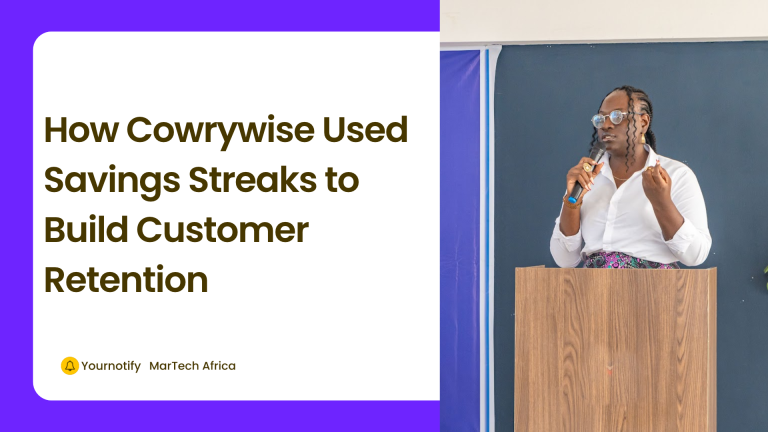
At MarTech Africa 3.0, Omolade Marquis, Senior Growth Marketer at Cowrywise, explained how the fintech company used savings streaks, automation and customer recognition to encourage users to save consistently.
Rather than treating deposits as isolated transactions, the platform made saving progress visible and gave customers milestones they could celebrate. The approach also allowed users to share their achievements, creating opportunities for organic brand visibility.
MarTech Africa explored this strategy in its Cowrywise customer retention case study. The lesson for other businesses is simple: identify the customer behaviours that create long-term value, then find meaningful ways to recognise them.
A good milestone reward should reinforce progress that benefits the customer, not encourage unnecessary spending simply to maintain a streak.
7. Use Rewards to Re-Engage Inactive Customers
Sometimes, a customer stops purchasing without being dissatisfied. They may forget about the business, switch temporarily to another brand, or simply have no immediate reason to return. A carefully timed reward can create an opportunity to reconnect.
For example, a fashion retailer might identify customers who previously purchased every month but haven’t placed an order in the past 90 days. Instead of sending a generic promotional message to the entire customer database, it could create a specific reactivation campaign for those customers.
The campaign might include an exclusive voucher, a relevant product recommendation or an invitation to explore a new collection.
Rewards are not always the right solution. If customers stopped buying because of poor service, delivery problems, or product quality issues, a discount alone won’t resolve the underlying problem. Businesses should investigate why customers disengaged before deciding what incentive to offer.
For additional ideas, see MarTech Africa’s guide to customer retention strategies for African markets.
How to Build a Customer Rewards Programme in Nigeria
A customer rewards programme doesn’t need to be complicated to be effective. What matters is having a clear objective, a reward customers value, and a reliable way to measure results.
Step 1: Decide Which Behaviour You Want to Encourage
Are you trying to increase purchase frequency, improve customer retention, attract referrals, or reactivate inactive customers? Choose one primary objective before designing the reward.
For example, if the problem is that customers rarely return after their first purchase, focus on improving the second-purchase rate.
Step 2: Choose a Reward That Matches Your Audience
Ask customers what they value. Some may prefer discounts, while others may find airtime, data, free delivery, or exclusive benefits more useful. Avoid choosing a reward simply because it is easy for the business to distribute.
Step 3: Set Clear Earning and Redemption Rules
Define who qualifies, what action earns a reward, how customers claim it, and whether it expires. Keep the conditions easy to understand.
Step 4: Connect Rewards to Customer Communication
A rewards programme loses value if customers don’t know they have earned something. Use appropriate email, SMS or WhatsApp messages to explain programme benefits, confirm rewards and communicate relevant updates.
Step 5: Monitor Performance and Costs
Measure whether rewarded customers are returning more frequently and whether the additional purchases justify the cost of the incentives. This matters because an increase in sales doesn’t always mean an increase in profit.
How to Measure Customer Reward Programme Success
Businesses should evaluate customer rewards using actual purchasing behaviour rather than the number of people who joined a loyalty programme.
Here are some important metrics:
| Metric | What It Measures |
| Repeat purchase rate | Percentage of customers who make another purchase within a defined period |
| Purchase frequency | Average number of orders placed per customer |
| Reward redemption rate | Percentage of issued or earned rewards redeemed |
| Customer retention rate | Percentage of customers retained over a defined period |
| Average order value | Average amount spent per transaction |
| Reward cost | Total cost of incentives and programme administration |
| Incremental contribution | Additional contribution earned after accounting for reward costs |
Scroll horizontally to see all columns.
Example: Calculating Repeat Purchase Rate
Suppose an online retailer acquires 200 customers during a month.
Within the next 60 days, 70 of those customers make another purchase.
The repeat purchase rate for that cohort is:
70 ÷ 200 × 100 = 35%
This means 35% of those customers made at least one repeat purchase within the measurement window.
The retailer can compare this result with similar customer groups or earlier periods to understand whether its reward programme is associated with improved repeat purchasing.
However, an increase in repeat purchases doesn’t automatically mean the rewards caused the improvement. Seasonality, pricing, and product availability may also affect customer behaviour.
Don’t Ignore Profit Margins
Imagine a retailer sells a product for ₦20,000 and earns a 25% contribution margin before rewards. That leaves ₦5,000 in contribution. If the retailer offers a ₦1,000 reward on the purchase, the contribution falls to ₦4,000 before any additional programme costs.
The business must determine whether that incentive generates enough additional purchases or customer value to justify the reduction. This is why reward programmes should be designed around commercial objectives, not just customer excitement.
Common Customer Rewards Mistakes Nigerian Businesses Should Avoid
A reward programme can attract attention and still fail to improve long-term retention.
Some common mistakes include:
Offering rewards customers don’t value: A benefit that feels irrelevant won’t motivate repeat purchases.
Making rewards difficult to redeem: Complicated claim processes can create frustration.
Giving away too much: Incentives that significantly reduce margins can make the programme financially unsustainable.
Failing to communicate reward balances: Customers may forget about benefits they don’t know they have earned.
Rewarding behaviour that would happen anyway: Giving incentives to every existing purchase can increase costs without generating additional sales.
Ignoring customer privacy: Reward programmes collect customer information, and businesses must handle that data responsibly.
Nigeria’s Data Protection Commission oversees the country’s data protection framework, including rules relevant to direct marketing and the use of personal information.
Businesses should ensure that marketing communications comply with applicable consent requirements and provide customers with appropriate ways to opt out.
There is another important consideration. Research discussed by Harvard Business Review in Why Customer Loyalty Programs Can Backfire highlights why poorly designed loyalty initiatives can create unintended consequences.
Customers should feel rewarded for choosing your business, not pressured into making unnecessary purchases or punished for temporarily disengaging.
Frequently Asked Questions
What are the best customer rewards for Nigerian businesses?
The best rewards depend on the audience and business model. Common options include loyalty points, cashback, discounts, airtime, data, vouchers, referral incentives, and exclusive customer benefits.
How can small businesses in Nigeria start a loyalty programme?
Small businesses can begin with a simple system that rewards a clearly defined action, such as a third purchase or successful referral. As customer numbers grow, loyalty and digital rewards tools can help automate record-keeping, eligibility checks, and reward distribution.
Can customer rewards increase repeat purchases?
Customer rewards can encourage repeat purchasing when the incentives are relevant, easy to redeem, and connected to a positive customer experience. Their effectiveness should be measured through customer behaviour and profitability rather than assumptions.
What is the difference between customer rewards and customer loyalty programmes?
A customer reward is an incentive for a particular action. A loyalty programme is an ongoing system that recognises customer activity and provides benefits over time.
What platforms can Nigerian businesses use to manage customer rewards?
Businesses can use loyalty and reward management platforms such as Yournotify to configure earning rules, manage digital incentives, coordinate customer communication, and track campaign performance. The appropriate platform depends on the business’s requirements, integrations and budget.
Conclusion
Customer rewards can help Nigerian businesses encourage repeat purchases, but the most effective programmes do more than offer discounts. They recognise valuable customer behaviour, make returning worthwhile and strengthen relationships that already have a foundation in good products and service.
For some businesses, that might mean loyalty points or exclusive offers. For others, it could involve airtime rewards, referral incentives, personalised communication or recognising meaningful customer milestones.
Marketing technology can make these programmes easier to manage, especially as customer numbers and communication needs grow. The important thing is to keep the programme simple, relevant and measurable.
A reward might encourage a customer to make another purchase. A consistently valuable experience gives them a reason to keep choosing your brand.
For more practical insights on marketing technology, customer engagement and business growth across Africa, join the MarTech Africa community.